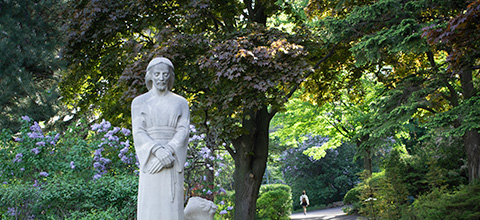
Iris "Frere Andre"
Hybridizer by M. Elaine Bessette, R., 1996
Blossoming: late May, early June


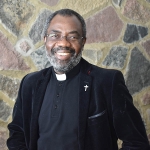
A Message from the Rector 
Winter 2012 click here 


Masses in Spanish
Todos los primeros domingos del mes, se celebrará una misa en
español en la cripta, a las 3 P.M.
Todos son bienvenidos.

On the first Sunday of each month, a mass in Spanish will be held in the crypt at 3 PM. Welcome to all! click here


Renovation of the Beckerath Organ in the Basilica
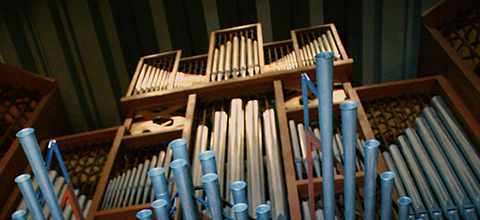
Renovation work on the Beckerath organ in Saint Joseph's Oratory basilica began August 29, 2011 and will continue until May/June 2012. The Sunday organ concerts remain at 3:30 p.m., but using the Rogers organ, located in the sanctuary area of the basilica. Thus, music lovers can still come and listen to the recitals offered by noted organists.


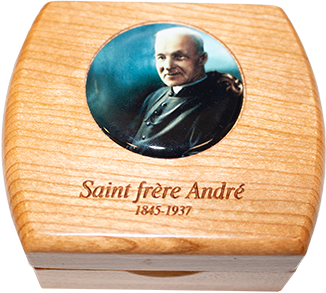
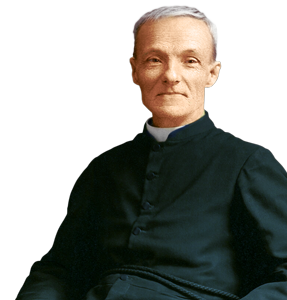
The reliquary of Saint Brother's André 
Saint Brother André's reliquary in your parish.
Information, click here


The Tomb and the Heart of Saint Brother André


Pope John Paul II in front the Tomb of Saint Brother André in 1984.
Photo: Murray Musher


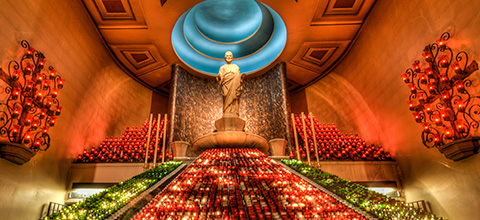
Saint Brother André’s tomb is behind the central lamp-stand in the Votive Chapel. He died January 6, 1937 at the age of 92. His body was entombed in an alcove in a small memorial chapel. It is an old ecclesial tradition to safeguard the remains of those who have lived an exemplary spiritual life. Thousands of witnesses have testified to Saint Brother André's a heroic embodiment of the virtues of his religious life and baptismal faith. On the 11th of September, 1963, the ecclesiastical tribunal overseeing the cause for his beatification opened the tomb to verify the authenticity of the remains.

The brick arch over the tomb was designed by the architect Dom Paul Bellot, O.S.B., as was the black marble sarcophagus donated by the Honourable Maurice Duplessis, Prime Minister of Quebec and a friend of Saint Brother André. Pilgrims kneel before the tomb touching it to feel closer to Saint Brother André.
 
The fresco behind the tomb was painted by the artist Henri Charlier. It illustrates Saint Brother André’s fidelity to Our Lord’s passion. It bears the inscription, “Poor, Obedient, Humble Servant of God.” On the opposite wall is a bust of this apostle of Saint Joseph. Beneath it are open registers where pilgrims can add their signature to those of the millions who have entered their names in support of the canonization of Saint Brother André. Canonization is considered the ultimate affirmation of a life offered to God in service to others.
 
 
The Heart of Saint Brother André
At the time of Saint Brother André’s death, the Archbishop of Montreal, George Gauthier, suggested reviving of a little known custom of the Middle Ages. In medieval France and Italy, when people of note passed away their hearts were often removed from their bodies before burial and preserved as a token of admiration or recognition. The hearts of the kings of France were long preserved in this way. It was therefore decided to preserve Saint Brother André’s heart in a reliquary at the Oratory where it remains as a sign of his continuing spiritual presence among us.
During the night of March 15, 1973, someone removed the reliquary containing the heart of Saint Brother André from its shrine. Eventually, it was discovered in the basement of a home in South Montreal on December 21st, 1974, based on a tip received by the police. It was put back on display with the addition of a security system,  so that it could continue to serve as an object of contemplation for pilgrims. In this way, we remain close to Saint Brother André's heart, both literally and figuratively. The reliquary is in the museum that portrays scenes from Saint Brother André's life.

Photo: Paul Simon
 
Exhibition on the life and work of Saint Brother André
An exhibition on the life and work of Brother André is located near the relic of Saint Brother André's heart, adjacent to the Joseph Olivier Pichette Hall.