Hybridizer by M. Elaine Bessette, R., 1996
Blossoming: late May, early June
| The Crypt Church and the Basilica |
| The Crypt Church |
| The Architecture of the Crypt Church |
|
Planning for the crypt church was entrusted to architects Dalbé Viau and Alphonse Venne. Built of concrete, it is covered with limestone from the Deschambault quarries, held in place by steel framing.
The commencement of the building project consisted of setting off dynamite to allow for the leveling of the site. However, during this phase, the engineers came to realize how hard the rock was and it was decided to abandon the idea of building the crypt church into the mountain side.
This church is called a “crypt” because it is located at the foot of the Basilica, and because its interior is formed by a series of vaults whose upper section has been somewhat flattened, thus making the interior space appear to be hollowed out under elliptical arches, reminiscent of ancient crypts. The crypt church is 200 feet long, 120 feet wide, and 40 feet high.
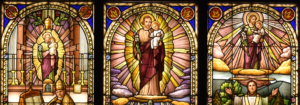
There are five openings in the exterior façade—a central portal and four stained-glass windows. As well, two other entrances are adjoined at each end of the façade. Aside each entrance, a circular staircase leads to a terrace on top of the crypt church. From this terrace, one can climb the stairway to the Basilica.
|
Photo: André Roussel |
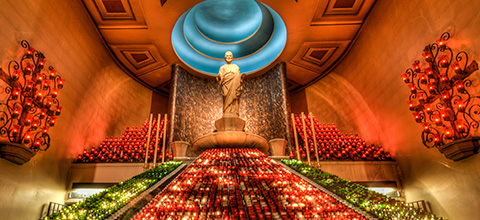
| The Interior of the Crypt Church |
|
In 1915, given the immense flow of people crowding the little oratory to invoke Saint Joseph and to meet Brother André, it was decided to raise up a great sanctuary. The plans envisaged a lower church with a grand basilica towering above. |
![]() Photo: Paul Simon |
| The Basilica |
|
Saint Joseph’s Oratory of Mount Royal is recognized as one of the foremost sanctuaries in the world visited by people seeking contemplation and spiritual renewal. It also attracts tourists who wish to see this architectural wonder and enjoy the spectacular view. Western Christianity has a number of such sites but only three in the hearts of a major cities;
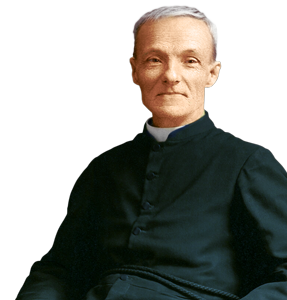
Saint Peter’s basilica in Rome, the Sacré Coeur in Paris, and Saint Joseph’s Oratory in Montreal. Why build an oratory? The idea came to Saint Brother André, a simple porter at College Notre-Dame, who wished to create a small shrine to Saint Joseph, the husband of Mary, to whom he was especially devoted. Despite the grandeur of the Basilica that now stands on Mount Royal, you can still find within its walls some of the intimacy that Saint Brother André wished his visitors to experience. It is here that gatherings of pilgrims are held. In the course of its history, the Basilica has been visited a number of major figures: Pope John Paul II in 1984, Mother Teresa in 1988, the Dalai Lama in 1993, and the relics of Saint Therese of Lisieux in 2001. The Basilica regularly hosts large diocesan assemblies and prayer services for peace.
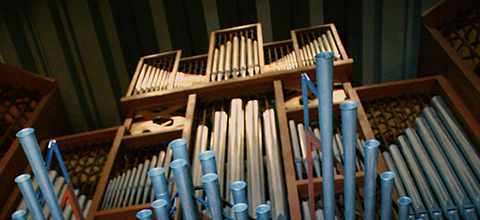
The basilica can seat up to 2,200 people. Sunday 11 a.m. services usually feature the Petits Chanteurs du Mont-Royal and the Beckerath great organ. The purity of its architectural lines and the refinement of its decorations make the basilica a place of prayer, peace and contemplation for believe and all people searching for meaning in their lives.
|
![]() Photo: Nathalie Dumas |
| The Architecture of the Basilica |
|
The exterior of the Basilica is in the style of the Italian Renaissance. Construction began in 1924 based on plans by Montreal architects Dalbé Viau and Alphonse Venne. When Saint Brother André died on January 6, 1937, the dome had not yet been built. That same year, the French Benedictine Monk, Dom Paul Bellot, in collaboration with Montreal architect Lucien Parent, undertook the completion of the Basilica.
The dome was poured and covered with copper. The towers and the base of the dome took on distinctive traits. The interior was completed in 1966, based on on designs by the Canadian architect Gérard Notebaert. Dimensions:
The Two Domes:
|
![]() Photo: Annick Robert |