| |
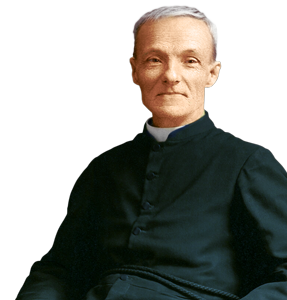
The Brother André: I am a man just like you
His name was Alfred Bessette. He was born on August 9, in 1845, and was so weak at his birth that his parents baptized him themselves the very next day, afraid he would not survive.
His family was poor, and in 1849, decided to move to Farham, Quebec where Alfred’s father hoped to earn a better living as a lumberjack. Unfortunately, he lost his life in a work accident, crushed by a falling tree when Alfred was only nine years old.
Alfred's mother found herself widowed at the age of forty with ten children in her care. Tree years later, she died of tuberculosis. Brother André would later say of her, ‘I rarely prayed for my mother, but I often prayed to her.’
The family was split up. At the age of twelve Alfred found himself having to face the hardships of life. Barely able to write his own name or read the prayer book, he was forced to find work and learn a trade. Alfred would spend the next thirteen years wandering from job to job with few belongings and little hope.
The Labourer
Alfred tried to make a living in spite of his physical weakness. He traveled from job to job as an apprentice and was easily exploited by those stronger than himself. For a time, he worked in construction, then as a farm boy, a tinsmith, a blacksmith, a baker, a shoemaker and a coachman.
Following the flow of French-Canadian emigrants, he went to the United States and worked in the textile mills for four years. Even if his health was poor, he put his whole heart into his work: ''Despite my weak condition'', he would say, ''I did not let anyone outdo me at work''. In 1867, he came back to Canada.
In 1870, Alfred presented himself as a candidate for novitiate of the Congregation of Holy Cross in Montréal. Because of his weak health, his superiors had doubts concerning his religious vocation. However, he was finally accepted and given the name of Brother André, along with the responsibility of porter at Notre-Dame College. Talking about his early duties at the college, Brother André was wont to say: ''When I entered community, my superiors showed me the door, and I remained there for 40 years without leaving''. On top of his porter duties, his daily tasks consisted of washing floors and windows, cleaning lamps, carrying firewood and working as messenger. |
 |
|
 |
| |
Brother André perpetual vows (Henri Larin, 1874) |
|
 |
|
 |
|
| |
The Friendly Brother
Soon, Brother André started to welcome the sick and broken-hearted. He invited them to pray to Saint Joseph to obtain favours. It was not long before many people woud report that their prayers had been answered. For twenty-five years, he spent six to eight hours a day receiving those who came to him, first in his small office, then in the tramway station across the street from the college. He built the first chapel with the help of friends and with the money he earned giving haircuts to the students of the college, He had the certitude that Saint Joseph wanted to have a place on the mountain: as a result, he spent his whole life preparing a beautiful shrine worthy of his friend.
Bother André began visiting the sick in the area and traveled as far as the United States where he had made friends. He earned the reputation of miracle-worker, but he vehemently rejected such a title: ''I am nothing… only a tool in the hands of Providence, a lowly instrument at the service of Saint Joseph''. He went even further stating: ''People are silly to think that I can accomplish miracles! It is God and Saint Joseph who can heal you, not I. I will pray Saint Joseph for you''.
His aloofness in the presence of strangers contrasted sharply with the carefree and humorous attitude he adopted among friends. He loved to tease and would often say: ''You must not be sad: it is good to laugh a little''. He made good use of his humour to share his joy and subtly slip some good advice into a conversation, or to change the subject when a conversation was developing into nasty gossip at someone’s expense.
He was a man of determination and uncompromising principles. Kindness and slightly impish wisdom were reflected in his eyes. He was known to be a very sensitive man. At times, he could be seen crying with the sick, or would be moved to tears by the sorrows confided in him by his visitors.
A Man of Great Undertaking
During all these years, an immense project was underway and crowds flocked to the Oratory in ever increasing numbers. The first small chapel was erected in 1904, but it was soon too small to receive all the people who came to the mountain. As a result, the chapel was extended in 1908, and then again in 1910. However, this was still not enough: a larger church in honour of Saint Joseph was needed.
In 1917, a new crypt-church was inaugurated that was able to hold over a thousand people. However, this was only the starting point of an even greater endeavour. Brother André devoted his efforts to building the Oratory, which was to become the world’s largest sanctuary dedicated to Saint Joseph.
The economic crisis of 1929 forced the construction of the Basilica to come to a halt. In 1936, the authorities of the Congregation of Holy Cross called a special meeting to decide if the project should continue or not. The Provincial summoned Brother André to ask for his opinion on the matter. The aging Brother André had only a few words for the assembly: ''This is not my work, it is the work of Saint Joseph. Put one of his statues in the middle of the building. If he wants a roof over his head, he ''ll take care of it.’’ Two months later, the Congregation had raised the funds necessary to continue working on the construction.
 |
|
 |
| |
Brother André in front of the crypt |
|
 |
|
 |
|
|
A Kind-hearted, Devoted Man
Brother André took great care in meeting and greeting people. He spent long hours in his office where thousands of people came to see him and, in the evenings, he visited homes or hospitals accompanied by one of his friends.
His kindness and compassion where matched by a remarkable lucidity. About the numerous requests for healings he would say: ''It is surprising that I am frequently asked for cures, but rarely for humility and the spirit of faith. Yet, they are so important…’adding, ''If the soul is sick, one must begin by treating the soul.'' Consequently, he would often ask the people who came to him questions such as, ''Do you have faith?'' ''Do you believe that God can do something for you?'' Then, before doing anything else, he would tell them, ''Go confess yourself to the priest, go to communion and then come back to see me.'' Brother André had a true understanding of the meaning and the value of suffering, and had wise words to say on the topic: ''People who suffer have something to offer to God. It is a daily miracle when they succeed in enduring their suffering!'' |
| |
|
A Man of God
Brother André always denied that he had any gift of healing, saying ''I have no gift nor can I give any.'' His advice was always the same: make a novena to Saint Joseph and rub oneself with Saint Joseph's oil or a medal of the saint. For him, these were true ''acts of love and faith, of confidence and humility.''
He encouraged people to see a doctor for treatment. As to the doctors themselves, he would tell them, ''Yours is a great work. Your science was given to you by God: you must therefore thank Him and pray to Him.'' Brother André had such a way of speaking about God that he was able to sow seeds of hope in those. One of his friends stated: ''I never brought a sick person to Brother André without that person returning home the richer for their visit. Some were cured. Others died some time later, but Brother André had brought them peace of mind.'' |
 |
|
 |
| |
Brother André carrying a suitcase |
|
 |
|
 |
|
| |
The Road to Heaven
For Brother André, heaven is living in God’s house. In discussing death, he would say: ''You know, it is permitted to desire death if one’s unique goal is to go forward God… When I die, I will go to heaven I will be much closer to God than I am now I will have more power to help you.''
A few moments before his death, those around him heard him cry out, ''I am suffering so much, my God! My God''. And then, in a very weak voice, ‘Here is the grain,’ referring to the Gospel of John 12:24, ‘Unless the grain of wheat falls into the ground and dies it remains alone. But if it dies, it brings forth much fruit.’
One of Brother André's friends said of him: ''He spent his whole life speaking of others to God, and of God to others'', an apt assessment of Brother André’s life imbued with faith, and love. In examining his life, it is difficult to say at what point in his work ended and prayer began for the two seemed to flow so naturally into one another. He died on January 6, 1937, at the age of ninety-one. Newspapers reported that well over a million people attended his wake and burial. Today, his body lies in a simple tomb in the beautiful Oratory that rises so gracefully out of Mount Royal. To this day, thousands of visitors come to Saint Joseph’s Oratory to receive physical and spiritual healing. Even today, Brother André remains for us a living symbol of the Christian renewal in which we are all invited to share. Whatever Brother André was able to achieve through God’s grace, we are also able to achieve through that selfsame grace.
 |